Between the Last Bell and Dinner: The Four Hours That Quietly Decide Who Makes the Honor Roll
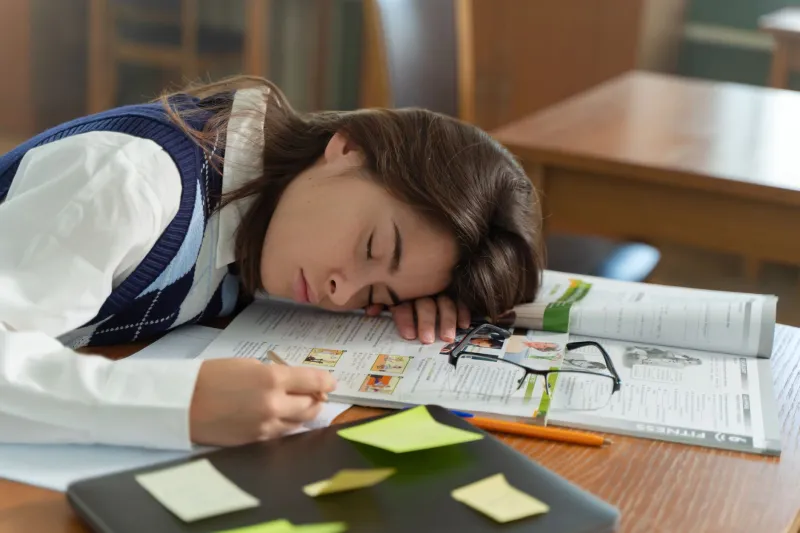
Ask any teacher and they'll tell you: something happens to a classroom around 1:30 in the afternoon. Eyelids get heavy, questions dry up, and even the sharpest students start staring through the whiteboard instead of at it. We tend to treat that fog as a character flaw — kids being lazy, teachers losing them. But the science says otherwise. The afternoon slump is a biological event, and what a student does in the four hours after the last bell might shape their GPA more than anything that happens before it.
The Crash Is Built Into Your Brain
Here's what's actually going on. Human alertness runs on two overlapping systems: the circadian rhythm, our roughly 24-hour internal clock, and something researchers call the sleep pressure system. From the moment you wake up, a chemical called adenosine builds up in the brain like sand in an hourglass. Around mid-afternoon — typically between 1 and 3 p.m. — that sleep pressure hits a temporary peak while the circadian alerting signal dips. The result is a natural trough that hits almost everyone, teen or adult, whether they ate lunch or not.
For teenagers, the problem is doubled. Adolescent circadian rhythms shift later during puberty, which is why so many high schoolers are fighting a losing battle at 7:15 a.m. By the time the final bell rings at 2:40, many American teens have been awake since dawn with a brain that's been running on fumes since first period.
The counterintuitive part? That same foggy window, handled well, is where the honor roll gets built.
Why the 2–6 P.M. Window Punches Above Its Weight
The typical American school day delivers six or seven hours of instruction. But instruction isn't learning — learning is what happens when the brain consolidates, practices, and connects new material. That process doesn't happen during lectures. It happens in the gaps: after school, on the bus, at the kitchen table.
Cognitive science has a name for this: the spacing effect. Material reviewed in short, spaced sessions — especially within 24 hours of first exposure — sticks dramatically better than material crammed later. A student who spends 20 minutes after school revisiting the day's chemistry notes is doing something a student who re-reads everything the night before the test simply cannot replicate, no matter how long they study.
Meanwhile, the hours between 2 and 6 p.m. are also when a lot of other stuff competes for attention: practice, jobs, scrolling, siblings. Whatever fills that window becomes the default pattern. And defaults, repeated 180 school days a year, become trajectories.
A Field Guide to the Afterschool Hours
So what does a well-designed afternoon actually look like? Not a minute-by-minute schedule — real life doesn't cooperate — but a rough architecture with three ingredients.
1. A genuine reset (the first 30–60 minutes). Students walk in the door with depleted working memory. Jumping straight into homework usually produces 40 minutes of work that should have taken 15. A real break — a snack, a walk, shooting hoops, even a 20-minute nap — isn't wasted time. It's the decompression that makes focused work possible. (Note: naps longer than 25 minutes risk grogginess, and anything after 4 p.m. can sabotage bedtime.)
2. The 20-minute review (before dinner). This is the highest-leverage move of the entire day. Sometime between arriving home and eating, the student spends 15–20 minutes skimming the day's notes — not doing homework, just reviewing. Fresh material gets a second exposure while the memory trace is still warm. Over a semester, this habit quietly outperforms weekend cram sessions by a mile.
3. Deliberate homework blocks (with a hard stop). After dinner, alertness rebounds naturally — the circadian system throws off a second wind in the early evening. That's the window for actual homework, ideally in 25–45 minute focused blocks with short breaks. And critically: a hard stop. Homework that stretches past 10 p.m. trades tomorrow's attention for tonight's completion, and it's almost always a losing trade.
What Parents and Programs Can Do
Families don't need to run a boot camp. The most effective parental moves are structural, not supervisory: keep the after-school snack protein-forward instead of pure sugar, protect a consistent homework start time, and treat the 20-minute review as non-negotiable while letting everything else flex.
Afterschool programs have an even bigger opportunity. The best ones already stagger their schedules — physical activity first, snack second, academic support third — because they've learned experientially what the research confirms: you can't do homework at 3 p.m. with a brain that's crashing. Districts designing expanded learning programs should build the circadian dip into the blueprint rather than pretending willpower will overcome it.
The Bottom Line
We spend a lot of energy arguing about school start times, class sizes, and curricula — all worth debating. But the honor roll isn't decided solely between bells. It's decided in the unglamorous stretch between the last bell and dinner, day after day, in a window most families never think to design.
The slump is real. It's also an opportunity. Students who learn to work with their biology — reset, review, then rebuild — turn the worst-feeling hours of the day into their quietest advantage. And unlike talent or test scores, that's a habit anyone can start tomorrow.