Cafeteria Duty Confidential: The Invisible Fifteen Minutes Where a School's Real Culture Gets Built

Ask any veteran teacher where the real work of a school happens, and they won't say the classroom. They'll say the doorway.
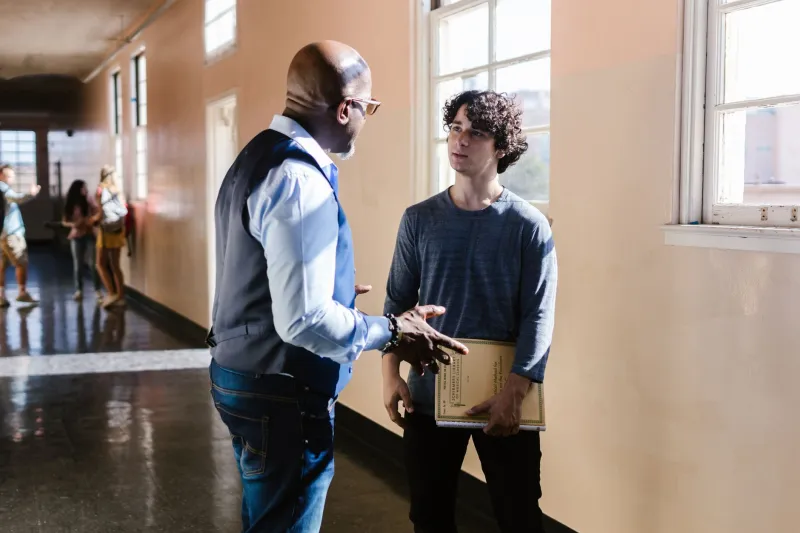
The doorway of Room 214, where a kid lingers an extra eight seconds because something is off at home. The hallway by the vending machines, where a colleague quietly says, "Hey, that observation went fine, stop spiraling." The cafeteria, where a teacher holding a lukewarm coffee somehow talks a freshman out of a terrible decision before fifth period.
None of this shows up on an evaluation rubric. All of it is the job.
The Economy Nobody Budgeted For
Spend a week watching a typical American middle or high school and you start noticing what I've come to call the lunchbox economy — an informal system of small, unpaid, unscheduled exchanges that hold a building together.
A teacher on cafeteria duty isn't just supervising trash disposal. She's the only adult some students interact with all day who isn't asking them for an assignment. A math teacher standing in the copier line isn't wasting time; he's troubleshooting a lesson plan with the science teacher two people behind him. These moments are cheap, frequent, and — according to a growing number of school culture researchers — disproportionately powerful.
The problem? They're also the first thing to get squeezed when a schedule gets tight. Mandatory intervention blocks, back-to-back class rotations, data meetings scheduled over lunch — modern school calendars are engineered like airline seats, maximizing every minute of "instructional time" while quietly deleting the connective tissue between minutes.
What the Fifteen Minutes Actually Does
Here's the uncomfortable truth for anyone who loves a spreadsheet: the mentoring that changes a student's trajectory rarely happens during a scheduled meeting. It happens in the margins.
A student won't book an appointment to say they're struggling. But they'll hover near a teacher they trust during lunch duty and mention, almost accidentally, that things at home are rough. That hovering requires two things: an unstructured window, and an adult who isn't rushing somewhere else.
The same logic applies to staff. Schools spend thousands on professional development consultants while the most effective PD in the building — two teachers comparing notes on a struggling kid for four minutes in a hallway — costs nothing and gets scheduled over constantly.
How Schedules Eat the Margins
It's rarely malicious. Administrators face state testing windows, mandated minutes, bus schedules, and contractually capped teacher workloads. Something has to give, and the thing that gives is always the same: the time that was never officially on the calendar to begin with.
But there's a difference between efficient and hollow. A school can hit every required instructional minute and still feel like a building full of strangers. Ask around any district and you'll hear versions of the same story: the year the advisory period got cut, the hallway felt different by October.
Protecting the In-Between
If you run a school — or want to influence whoever does — here's what actually works:
- Put margins on the master schedule. If it isn't scheduled, it doesn't exist. Build a protected five-minute buffer into transitions and treat it as sacred, not spare.
- Rotate duty assignments for coverage, not punishment. Cafeteria and hallway duty should be shared equitably so no single teacher bears the whole invisible workload — and so more adults are visible in more places.
- Stop scheduling over lunch. Full stop. A 22-minute lunch with a meeting invitation attached is not a lunch.
- Name the work. When evaluations or staff shoutouts only recognize classroom performance, the hallway mentoring stays invisible. Recognize it out loud.
- Design gathering spaces on purpose. A staff lounge that's a converted storage closet sends a message. So does a coffee station in the copier room.
The Case for Slowing Down
There's a certain irony in writing this for an audience obsessed with making every day count. But here's the thing: counting every day doesn't mean filling every minute. Some of the most valuable minutes in a school are the ones that look, from the outside, like nothing at all.
A teacher eating a sandwich at a table of sixth graders. Two colleagues laughing by the laminator. A kid who finally feels seen because an adult had fifteen minutes to spare.
That's not downtime. That's the infrastructure. And it deserves a line on the schedule before anything else gets one.